


Traumatic Brain Injury Center Laboratory
Traumatic brain injury (TBI) has long been one of the traditional areas of clinical and academic strength at Tianjin Huanhu Hospital. The Traumatic Brain Injury Center Laboratory is headed by Professor Yan Hua. The laboratory is dedicated to elucidating the mechanisms underlying secondary injury after TBI and translating these discoveries into clinical practice. With a particular focus on cutting-edge research into multisystem interactions along the “brain-organ axis,” the laboratory has become an important regional center for brain injury research.
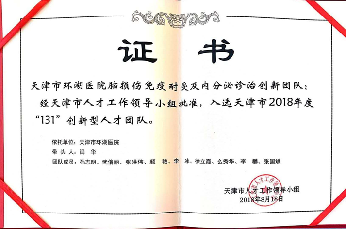
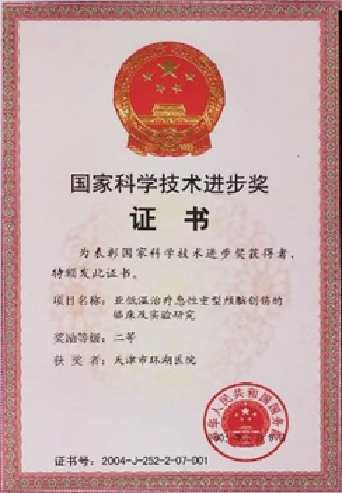
The laboratory has maintained a longstanding commitment to TBI research. In 2004, its project entitled “Clinical and Experimental Study of Mild Hypothermia for the Treatment of Acute Severe Traumatic Brain Injury” received the Second Prize of the National Science and Technology Progress Award (No. 2004-J-252-2-07-D01), establishing the discipline as a national leader in this field. The team has subsequently received multiple provincial-and ministerial-level science and technology awards. In 2013, the project “Endocrine Study on Early Surgical Reduction of Limb Fractures in Traumatic Brain Injury Patients” received the Third Prize of the Tianjin Science and Technology Progress Award (2013JB-3-121-R1). In 2016, the project “Mechanisms and Clinical Applications of Immune Tolerance in the Treatment of Traumatic Brain Injury” received the Second Prize of the Tianjin Science and Technology Progress Award (2016JB-2-040-R1). In 2018, the laboratory’s core team, the “Tianjin Huanhu Hospital Innovation Team for Immune Tolerance and Endocrine Diagnosis and Treatment of Brain Injury,” was selected for the Tianjin “131” Innovative Talent Team Program.
Over the past three years, the laboratory has published nearly 20 SCI-indexed papers in leading international journals, including two original research articles in the Journal of Neurotrauma, a leading journal in the field of traumatic brain injury, and one article in Science Advances. Notably, the paper published in Science Advances was featured as one of three highlighted articles on the journal’s homepage for its corresponding issue.