


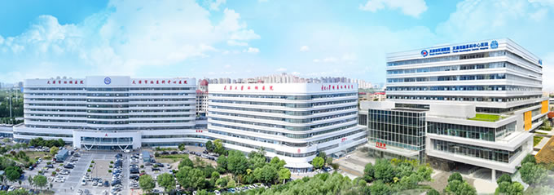
Tianjin Huanhu Hospital, also known as Tianjin Neurological Center Hospital and Tianjin Institute of Neurosurgery, derives its name from its location near Tianta Lake. Officially inaugurated in 1988, the hospital is a Grade III Class A public specialized hospital dedicated to the diagnosis and treatment of neurological and neurosurgical diseases, as well as scientific research, education, and training. In 2021, it was designated as a co-construction institution for the National Regional Medical Center for Neurological Diseases under a joint initiative of the National Health Commission and the Tianjin Municipal Government.
The Hospital’s Department of Neurosurgery is designated as a National Clinical Key Specialty, while comprehensive diagnosis and treatment of cerebrovascular diseases and the brain science program, particularly in the field of brain–computer interfaces, have been selected as National Clinical Key Specialty development programs.
The Hospital is home to two Tianjin municipal key laboratories: the Tianjin Key Laboratory of Cerebrovascular and Neurodegenerative Diseases and the Tianjin Key Laboratory for Translational Research on Cerebral Blood Flow Reconstruction and Innovative Technologies for Head and Neck Tumors.
The Jizhao Campus in Jinnan District currently has 1,180 beds. The Tianta Campus in Hexi District, with a capacity of 400 beds, was completed and officially opened in October 2025, establishing a dual-campus model of operation.
The Hospital currently has 7 experts receiving special government allowances, 2 members of the inaugural national cohort of high-level medical professionals, 2 experts recognized for outstanding contributions to Tianjin, 1 Haihe Medical Scholar, and 7 Tianjin Distinguished Physicians, together with nearly 100 doctoral and master’s supervisors.
The Hospital has 3 National Clinical Key Specialties, 11 national-level training bases, 3 municipal key disciplines, 2 municipal key laboratories, 1 Tianjin Institute of Neurosurgery, 1 professional journal indexed by two major Chinese core-journal systems, and 3 municipal clinical quality-control centers.
The Hospital has 1,926 employees, including 122 professionals with senior titles, 206 with associate senior titles, and 570 staff members holding master’s degrees or above. It also has 10 experts receiving special allowances from the State Council and continues to select outstanding professionals for government-sponsored overseas study and training.
Tianjin Huanhu Hospital has strong disciplinary capabilities and is Tianjin’s only National Demonstration Advanced Stroke Center, the leading institution for cerebrovascular disease prevention and control in Tianjin, and the coordinating institution for the Tianjin Stroke Emergency Map.
Neurosurgery is one of the Hospital’s principal areas of clinical excellence. The Hospital has developed distinctive strengths in the surgical and endovascular treatment of cerebrovascular diseases, comprehensive treatment of intracranial tumors through microsurgery, radiotherapy, and chemotherapy, as well as the management of severe traumatic brain injury. These programs have reached an advanced level nationally.
The Hospital has particular expertise in cerebral revascularization and bypass surgery, especially posterior-circulation bypass procedures and high-flow bypass for giant vertebrobasilar aneurysms, in which it is among the leading centers in China. The annual number of intravenous thrombolysis procedures for acute ischemic stroke performed at the Hospital has ranked first among individual centers in China for multiple consecutive years.
The Department of Neurosurgery includes specialized teams in cerebrovascular surgery, neuroendovascular intervention, neurotrauma, intracranial tumors, pediatric neurosurgery, functional neurosurgery, and spinal neurosurgery.
The Department of Neurology includes specialized teams focusing on cerebrovascular diseases, epilepsy and sleep disorders, neurogenetic and neurodegenerative diseases, neuropsychology and dementia, neuroimmunological diseases, neuromuscular disorders, central nervous system infections, and neurocritical care.
Since 2019, the Hospital has comprehensively strengthened its disciplinary development strategy and vigorously promoted a model characterized by specialization, integration, and center-based development. By integrating clinical and academic resources across the Hospital, it has successively established the Endoscopic Skull Base Center, the Integrated Cerebrovascular Care Unit, the Head and Neck Neuro-Oncology Center, and the Functional Neurological Disorders Diagnosis and Treatment Center.
The Endoscopic Skull Base Center was the first neurosurgical endoscopy center in China established according to the Pittsburgh model. By integrating neurosurgery with ophthalmology and otolaryngology–head and neck surgery, the Center has developed a genuinely multidisciplinary model that overcomes the limitations associated with excessive fragmentation of clinical specialties and isolated technical approaches.
Following five years of rapid development, the Endoscopic Skull Base Center has established long-term and close collaborations with the Stanford University School of Medicine and Peking Union Medical College Hospital, integrating anatomy, clinical practice, education, and scientific research. Its professional training programs have consistently attracted strong participation.
In December 2021, the Hospital appointed Academician Ji Xunming, then Vice President of Capital Medical University, as Chief Expert of its cerebrovascular program and established the Integrated Cerebrovascular Care Unit by bringing together multidisciplinary resources.
This marked an important first step in breaking down traditional disciplinary barriers and providing patients with ischemic stroke with an integrated, one-stop pathway encompassing intravenous thrombolysis, bridging mechanical thrombectomy, and hybrid surgical treatment for vascular stenosis.
This patient-centered reform of the diagnosis and treatment model has effectively reduced disability and mortality among patients with severe cerebrovascular diseases and has generated significant clinical and social benefits.
In 2023, the Hospital ranked among the top three Advanced Stroke Centers nationwide for endovascular recanalization procedures. A total of 747 endovascular procedures were performed during the year, accounting for 66% of the 1,131 procedures performed across Tianjin.
The Head and Neck Neuro-Oncology Center specializes in multidisciplinary comprehensive treatment for benign and malignant neurological tumors, head and neck tumors, and related tumors involving other anatomical regions.
The Center integrates the strengths of multidisciplinary teams across the Hospital, including neurosurgery, ophthalmology, otolaryngology–head and neck surgery, medical oncology, radiation oncology, minimally invasive intervention, pathology, medical imaging, and rehabilitation.
Through coordinated multidisciplinary care, the Center has established a distinctive Huanhu model for comprehensive diagnosis and treatment of head and neck tumors and neurological tumors. It is committed to providing high-quality and standardized medical care, with the ultimate goals of preserving function, improving quality of life, and prolonging survival, while developing a nationally leading and internationally competitive high-level discipline cluster in head and neck neuro-oncology.
The Hospital’s work in functional neurological disease dates back to the 1980s, when the discipline was founded by renowned neurosurgeon Professor Zhao Keming.
To explore new fields and emerging technologies in functional neurological disorders and to meet growing patient needs for functional recovery, the Hospital established the Functional Neurological Disorders Diagnosis and Treatment Center in 2023.
Centered on disease-specific programs and electrophysiology as a core technological platform, the Center integrates neurology, neurosurgery, neurorehabilitation, and related disciplines to provide a new model of one-stop multidisciplinary medical care.
The Center maintains long-term research collaborations with Tianjin University, Nankai University, Hebei University of Technology, and other leading Chinese universities in the fields of brain science and neural engineering. These partnerships have established a medical–engineering collaborative platform for the prediction, diagnosis, rehabilitation, and treatment of major neurological disorders, including epilepsy, Parkinson’s disease, cognitive impairment, and post-stroke dysfunction, thereby creating distinctive strengths in functional neurological medicine.
Under the leadership of the Hospital, a nationally leading neurological specialty alliance with an international cooperation strategy is also being developed. The Hospital has established close collaborations with Shenzhen People’s Hospital, General Hospital of the Xinjiang Military Command, Affiliated Hospital of Qinghai University, Inner Mongolia People’s Hospital, and Xingtai Central Hospital.
Under the leadership of the hospital’s Party Committee, Tianjin Huanhu Hospital remains committed to a people-centered approach that places life and health first. Guided by a patient-centered philosophy, the hospital continues to advance institutional and operational reforms, promote healthy lifestyles, optimize healthcare services, strengthen health protection and support systems, and foster a health-supportive environment.
Looking ahead, the hospital will continue to build on its distinctive strengths in the neurosciences, pursue innovation-driven development and talent development strategies, enhance its clinical capabilities, and strengthen the integration of medical care, scientific research, and education. Through these efforts, Tianjin Huanhu Hospital is committed to achieving high-quality development and providing patients with advanced, efficient, and high-quality neurological and neurosurgical care.