
SCO Cooperation Shines in Tianjin | Tianjin Huanhu Hospital and Kazakhstan’s National Scientific Medical Center Conduct First Cross-Border Teleconsultation to Develop a New Surgical Treatment Plan
At the 7th Shanghai Cooperation Organization (SCO) Hospital Cooperation Conference, Kazakhstan’s National Scientific Medical Center and Tianjin Huanhu Hospital signed a cooperation agreement. Recently, the two institutions conducted a cross-border teleconsultation, successfully helping a patient in Kazakhstan recover through their collaborative medical efforts.
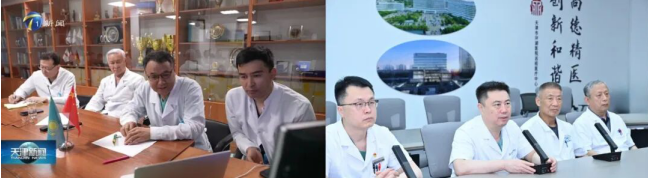
Agu, a 53-year-old resident of Almaty, Kazakhstan, had been experiencing progressive hearing loss in his left ear over the past two years. Following a recommendation from a physician at a local hospital, he recently sought medical attention from Serik Duysenbi , Director of Kazakhstan's National Scientific Medical Center. After a comprehensive examination, Agu was diagnosed with an acoustic neuroma (vestibular schwannoma). Skull base surgery was recommended as the preferred treatment, with intraoperative electrophysiological monitoring considered essential. However, this presented a significant challenge for Serik and his team.
“As Kazakhstan lacks specialists trained specifically in intraoperative electrophysiological monitoring, our team has relatively limited experience in this area,” Serik explained.
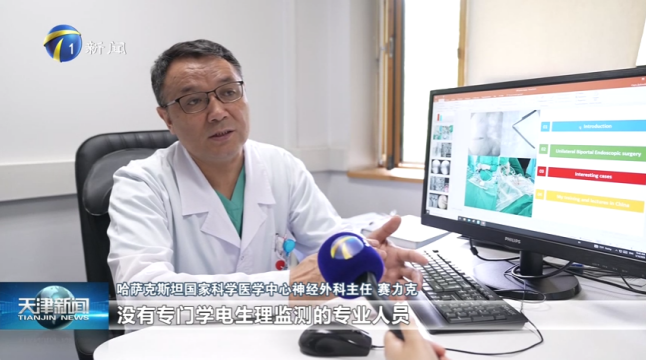
Serik previously worked as a cerebrovascular specialist at a hospital in China. During an academic exchange in 2017, he collaborated with Tong Xiaoguang, President of Tianjin Huanhu Hospital, on a complex skull base surgical procedure, marking the beginning of a lasting friendship.
Five years ago, Serik relocated to Kazakhstan to reunite with his family, who had been living there for many years. He subsequently joined the National Scientific Medical Center of Kazakhstan, where he helped establish its Department of Neurosurgery. Throughout this process, Serik frequently sought advice from President Tong on introducing advanced medical equipment, building multidisciplinary medical and nursing teams, and developing standardized surgical protocols.
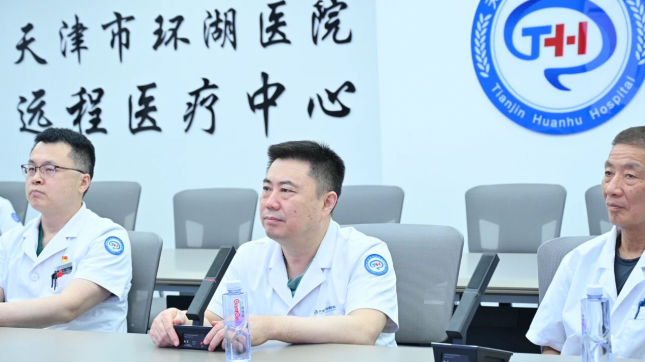
To ensure that Agu received the most appropriate treatment, the two institutions conducted their first cross-border teleconsultation. After reviewing Agu’s brain magnetic resonance imaging (MRI) scans, President Tong Xiaoguang and the medical team at Tianjin Huanhu Hospital determined that the tumor was relatively small and recommended Gamma Knife radiosurgery as an alternative to conventional skull base surgery. Compared with open skull base surgery, this minimally invasive approach avoids a surgical incision and generally allows for a faster recovery.
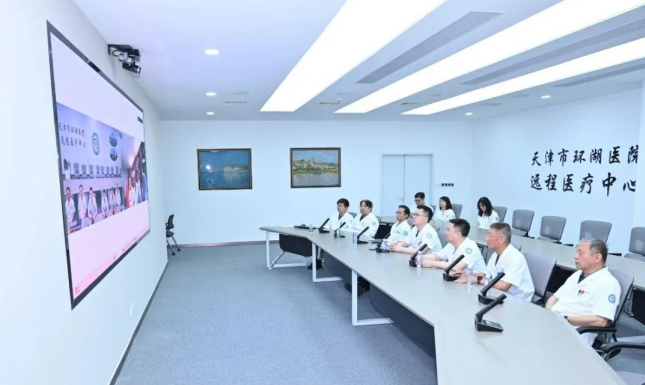
Agu has now completed his treatment and is recovering well. Expressing his gratitude to the medical team at Tianjin Huanhu Hospital, he said, “I am deeply grateful to the Chinese doctors for holding an online consultation with the physicians here. I am very pleased with this collaboration, and it has given me a great sense of reassurance and confidence.”
To further enhance neurosurgical expertise and clinical capabilities in Kazakhstan, the two hospitals, despite being thousands of miles apart, signed a cooperation agreement earlier this year. At the end of this month, eight Kazakhstani physicians will travel to Tianjin Huanhu Hospital to receive specialized training in intraoperative electrophysiological monitoring and other essential neurosurgical techniques, laying the foundation for independently performing complex skull base surgeries in the future. The two institutions will also exchange neurosurgical experts to provide clinical guidance and facilitate professional knowledge sharing. In addition, they are jointly working to establish Central Asia’s first training center dedicated to skull base surgery and cerebrovascular diseases, with the aim of training more highly skilled medical professionals, of strengthening local neurosurgical capabilities, and of providing high-quality medical services to patients across the region.
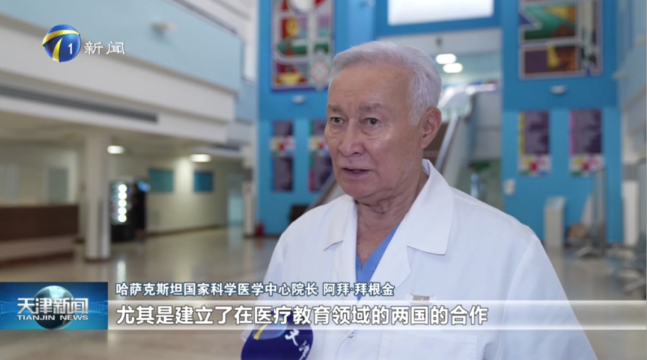
Abai Baigenzhin, President of the National Scientific Medical Center of Kazakhstan, stated, “Since the establishment of the Shanghai Cooperation Organization (SCO), cooperation between China and Kazakhstan, particularly in the fields of healthcare and medical education, has played a significant role in promoting the health and well-being of the people of both countries and fostering cultural exchanges.”